

We present to you the DIV (Dividend) strategy
We developed this strategy for investors who need a steady source of income. For example, retirees fall into this category. They need a steady income. And, for example, in the event of a market downturn, they cannot always wait a year or a year and a half for the market to recover. They need money to cover their current expenses. Therefore, we selected stocks that yield at least 3% per year.
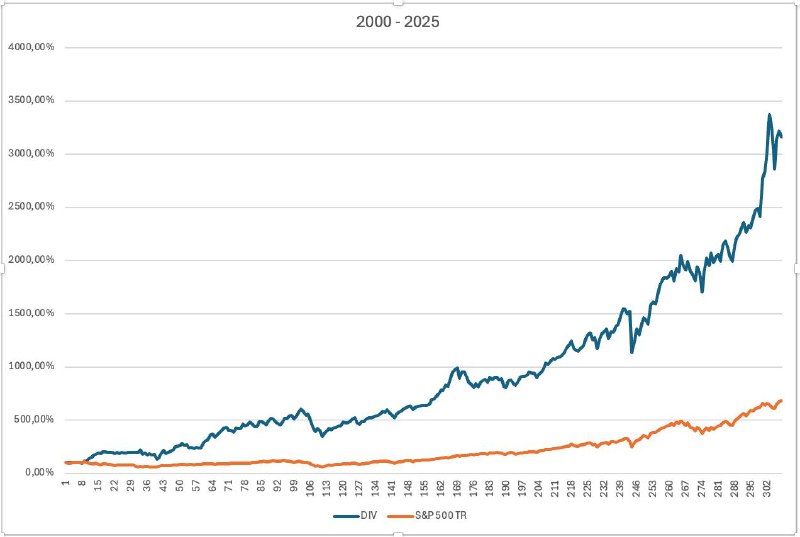
Here are our results. We present the strategy’s performance over 25 years, from 2000 to 2025. During this time, there were crises, periods of rapid growth, and periods of stagnation.
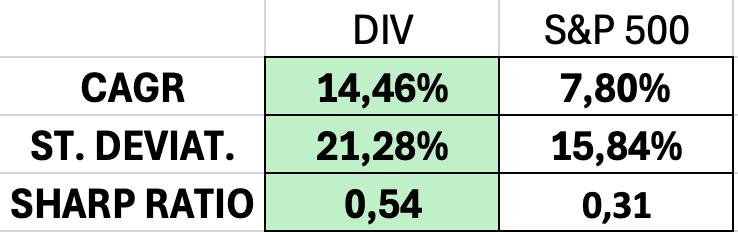
Although the strategy’s volatility was 34% higher than that of the benchmark, due to the fact that its return is nearly double that of the S&P 500, the strategy’s Sharpe ratio is significantly higher than that of the index.
Most importantly, the strategy generates a cash flow comparable to that of a U.S. bank deposit and yields a total annual return of 14.46% over a 25-year period.
Discussion on Telegram
Comments are machine translated from Russian.
- PrintABC 26.09.2025That sounds interesting; I’d definitely like to look into it. Roughly how much is the cash flow equivalent to a bank deposit in the U.S.?
- PrintABC 26.09.2025Does it yield a total annual return of 14.46% - is that the sum of dividends plus the stock’s price appreciation over the year?
- Starting at 3% per year
- It’s all in one: both growth and dividends.
- Does this assume that dividends are withdrawn or reinvested?
- Assuming reinvestment. Look, over a 25-year period, the strategy yields an average annual total return (dividends + price appreciation) of 14.4%. Dividends alone account for 3% or more per year. So, if you were to withdraw all dividends, you’d still be left with a return of 14.4% - 3% = 11.4%. And the market grows by an average of 7.8% over this period. In other words, under this scenario, your fund grows about 3.6% faster than the market - and that’s after you’ve taken out 3% in dividends. But if you withdraw, say, 2% for living expenses and reinvest the rest, your fund will still have an average annual growth rate of 12.4% after dividends are withdrawn.
Why might this be necessary? Let’s say I’m a retiree (which I am). I have a decent amount invested. And I’ve calculated that 3% of that amount per year is enough for me to live comfortably. I could go for a strategy that would give me 20% annually, but I’m afraid. After all, 20% is just an average. And the market experiences drawdowns. During drawdowns, you can’t sell because prices are low, but I need to eat all the time. This strategy was created to avoid those problems. I’ll get 3% from dividends (it focuses on dividend aristocrats, which have been paying dividends for decades and consistently increasing them). That way, market downturns don’t worry me. I live off the dividends. I don’t touch the stocks themselves. But you also need to factor in inflation and dividend taxes. However, those are matters of how you personally structure and manage your portfolio. We also offer this service, but for an additional fee 😊
Sign in with Telegram. Your comment will appear under the post in the channel.