

It’s time to take stock of our 5 months of investing across our four real-world
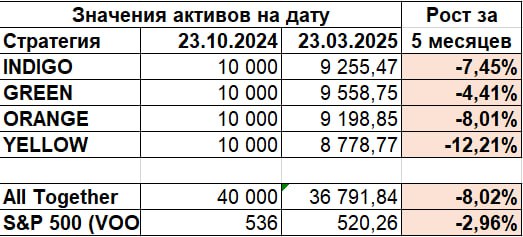
It’s time to take stock of the past 5 months of investing across our four real portfolios, built using AVI strategies on four accounts at Interactive Brokers. Screenshots showing what IB is reporting (all data as of the close of trading on Friday, March 21).
A summary of our account balances as of today is presented in the table. As we can see, the entire last column is colored pink. Over the past five months of our investment activity, we’ve been in the red across all strategies. Admittedly, the S&P market index is also in the red over these 5 months. But the index’s losses are smaller than those of our strategies: the index lost about 3%, while all strategies combined lost 8%.
Why strategies sometimes underperform the index
It’s worth noting one important feature of AVI strategies here. What we’re seeing now is by no means the last time AVI strategies will underperform the index. We’ve conducted thousands of experiments that show that none of these strategies consistently outperforms the market month after month.
The positive results of staying ahead of the market accumulate over time. Here’s how it works:
When the market declines, a portfolio built using the AVI strategy, on average and statistically, loses more than the market (which is what we’re seeing today). When the market rises, a portfolio built using the strategy, on average and statistically, gains more than the market. Portfolios built using these strategies are more volatile but also more profitable on average than investing “in the market.”
It follows from this that, on average, the extent to which the strategy outperforms the market is greater than the drawdowns incurred when investing according to the strategy during market declines. Consequently, a positive effect accumulates - over time, assets “following the strategy” end up, on average, so much higher than assets “following the market” that, despite their fluctuations, assets “following the strategy” never again fall below assets “following the market,” resulting in the strategy’s consistent outperformance relative to investing in a market index.
How long to wait
When does this happen? When does the AVI strategy’s outperformance over investing in a market index become absolute? The answer may disappoint some: it takes 4 to 7 years. Only after this period has elapsed does the “strategy-based” investment portfolio, regardless of market fluctuations, consistently outperform investing “in the market index” in terms of asset value at any given moment.
Is that a long time? In our view, no. After all, an investor has 20-30 years of investing ahead of them. But if you feel that’s too long, and you’re not prepared to wait and endure the fluctuations, then AVI strategies are probably not the right path for you.
P.S. It’s worth noting that working with AVI strategies is fundamentally different from using leverage. When investing in a market index with leverage, you simply amplify both the upward and downward fluctuations of the index by the same amount. But when using AVI strategies, you amplify upward movements to a greater extent than downward movements. This last statement, of course, holds true on average, statistically speaking, rather than for every single price movement. That’s why you need to accumulate a substantial amount of data for this effect to become apparent.
Screenshots and more details here: https://gregbar.livejournal.com/945307.html
Discussion on Telegram
No comments yet. Be the first!
Sign in with Telegram. Your comment will appear under the post in the channel.