

TRACK RECORD OF AVI STRATEGIES. 23.05.2026
In 2 parts. Part 2. (Part 1 is in the previous post: https://t.me/c/2157402613/267). Let’s discuss the observed results of the strategies over the past period. They are presented in four tables.
Three growth strategies
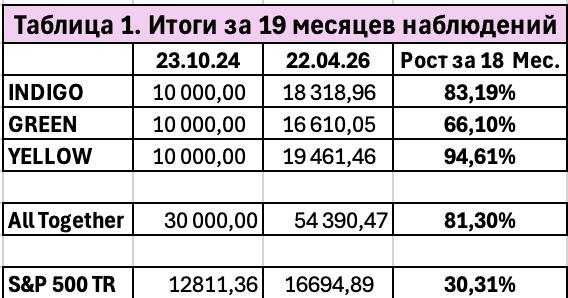
Table 1 - strategies we launched and began tracking on October 22, 2024. They are designed to deliver growth that significantly outperforms the market. It has been 19 months. Take a look at the results.
On average, the return on these 3 strategies over 19 months was 81.3%. Moreover, growth increased by 8.5 percentage points over the last month. Of course, such growth rates will not be sustained in the future; they will level off.
The market has also grown very significantly during this same period, with a 30.3% increase over 19 months. This is a rare stroke of luck. And it’s also safe to say with a high degree of certainty that the market will not continue to deliver such staggering results in the future.
It’s worth noting here that we’re deliberately talking about average growth rates. After all, each strategy has its own growth rate. For the GREEN strategy, it was 66.1%, and for the YELLOW strategy, 94.6%.
Those who have been following our track record for a long time know that during its first year, the YELLOW strategy was a consistent underperformer and only surged ahead in the last few months. That is why we consider a blended strategy the most sensible one. If you purchased three portfolios based on the three strategies, you not only achieved very high growth, but you also achieved significantly less volatile, more stable growth than you would have by following just one strategy.
New strategies and stable growth
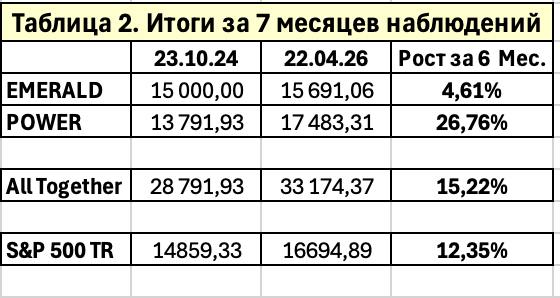
Table 2 presents the results for two new strategies that we launched on October 22, 2025. These strategies are also aimed at high growth. We hope that the growth for these strategies will be higher than for the three strategies in Table 1. However, we have only tracked them for 7 months so far, and it is still too early to draw any conclusions. Both strategies together are outperforming the market, though one is currently lagging behind the market while the other has pulled far ahead. But we’ve only been tracking them for 7 months. It’s far too early to draw any conclusions.
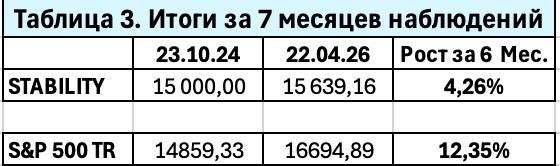
Table 3 presents a strategy designed not for exceptional growth, but for stable growth. According to our forecasts, this strategy’s growth is likely to be slightly higher than the market’s, while its volatility will be lower. Let’s see.
Dividend strategy
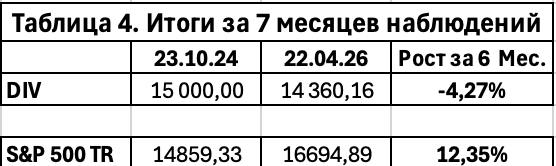
Finally, Table 4 presents the dividend strategy. It is currently underperforming the market. And most likely, it will not outperform it in the future either - at least not significantly. It has different goals - two of them, in fact.
First, it’s a good fit for people who live exclusively off the income from their investments. They need a stable cash flow without having to sell their stocks. Dividends are a decent option (though taxes do take a bite out of them).
The second goal is portfolio balancing. If you have several portfolios built using AVI growth strategies, it makes sense to add a small portion of a portfolio built using the DIV strategy to reduce the volatility of your assets’ growth. During times of crisis, portfolios of dividend aristocrats’ stocks often show growth. This reduces the volatility of an investor’s overall assets, allowing them to weather tough times with greater peace of mind.
Discussion on Telegram
No comments yet. Be the first!
Sign in with Telegram. Your comment will appear under the post in the channel.